

Sometimes, the need for funds comes up when you’re not really planning for it. And when that happens, the first question is usually where to arrange the money from.
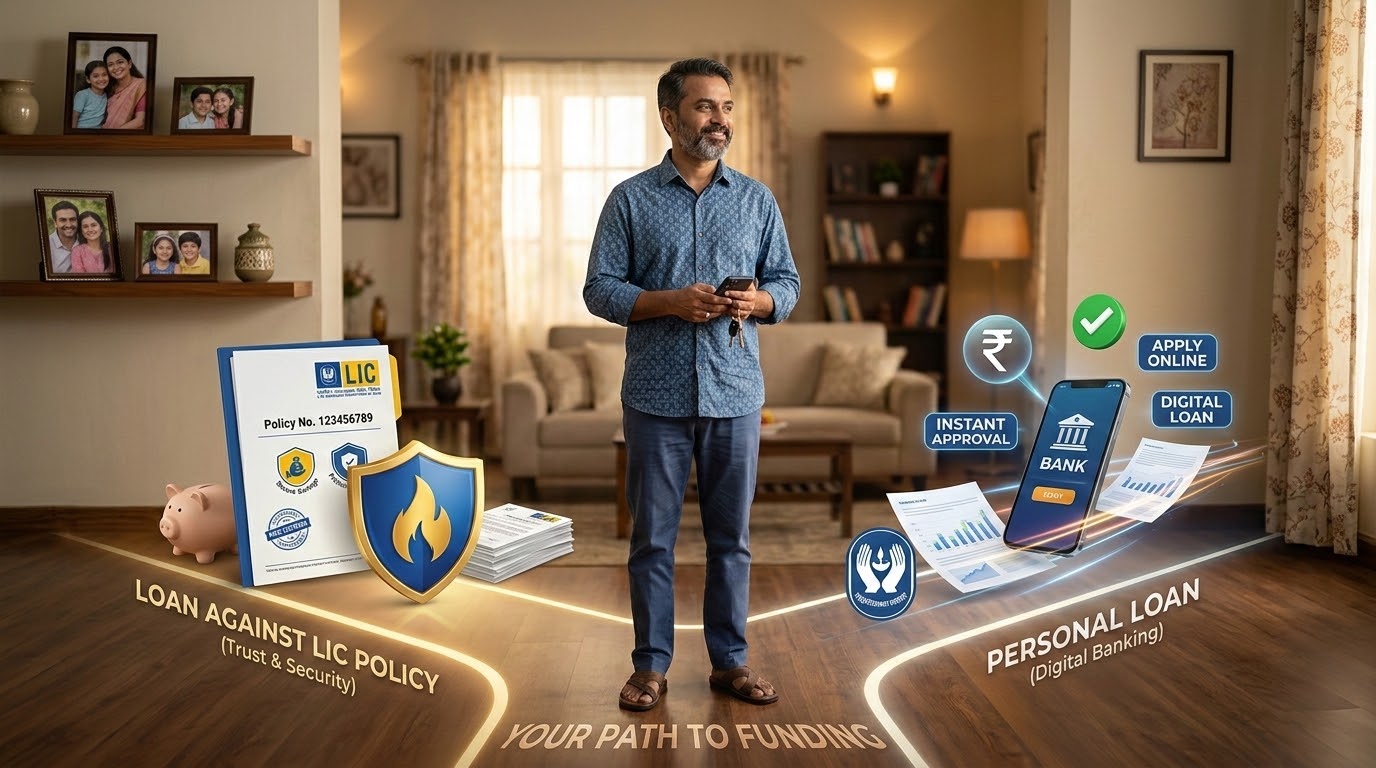
For most people, it usually comes down to either a personal loan or a loan against an LIC policy. Both work, just in slightly different ways.
A personal loan is one option, but if you already have a policy, that can also be used to arrange funds without giving it up.
- What is a Loan Against LIC Policy?
- What is a Personal Loan?
- Loan Against LIC Policy vs Personal Loan
- Why People Consider a Loan Against LIC Policy
- Key Benefits of Taking a Loan Against Your LIC Policy
- How the Process Usually Works
- Where BimaPay Fits In
- When Does a Loan Against LIC Policy Make Sense?
- Conclusion
- FAQs
What is a Loan Against LIC Policy?
A loan against an LIC policy is basically a way to use your policy to arrange funds when you need them.
Over time, certain LIC policies accumulate a surrender value. So, instead of closing your policy, you can simply borrow against its value.
Here’s how it works:
- The policy continues as it is
- You get access to funds when needed
- Repayment happens over time
This makes it a useful option when there is a need for funds without disturbing long-term plans.
What is a Personal Loan?
A personal loan is a loan you can take from a bank or lender without mortgaging any asset.
The approval mostly depends on your income, credit score, and your ability to repay.
Once it’s approved, the money is transferred to your account, and you pay it back in fixed monthly installments.
Loan Against LIC Policy vs Personal Loan
Both get you funds when you need them,the difference is in how they work
Here’s a quick comparison:
| Basis | Loan against LIC policy | Personal loan |
| Source of funds | Comes from the value your policy has built over time | Comes from the lender based on your eligibility |
| Approval process | Is usually quicker and simpler, as it’s backed by your policy | Depends on your credit score, income, and other checks |
| Interest rates | Usually has lower interest rates | Can have varying interest rates based on your profile |
| Impact on assets | Keeps your policy active, as you’re borrowing against it | Doesn’t involve any existing asset |
| Repayment | Offers more flexibility in repayment | Follows a fixed EMI structure |
This is why many people consider a loan against LIC policy when they already have a policy in place.
Why People Consider a Loan Against LIC Policy
For many, the decision is not just about getting funds, but also about how those funds are arranged.
A loan against LIC policy is often considered when:
- There is an immediate need for funds
- Existing investments should not be disturbed
- The policy has built sufficient value
- A simpler process is preferred
In many cases, it’s about using what already exists instead of starting fresh.
Key Benefits of Taking a Loan Against Your LIC Policy
1. You can arrange funds without stepping away from your policy
One of the main reasons people consider this option is that the policy continues as it is. You’re not required to surrender it or exit midway. So if you need funds, you can arrange them without affecting something you’ve been building for the long term.
2. It works better when your policy already has value built in
If your policy has accumulated value over time, you can use that to access funds. In such cases, you’re not entirely dependent on your income or credit score, which is usually the deciding factor in personal loans.
3. A more manageable option when cash flow isn’t fixed
Personal loans typically come with fixed EMIs, which can feel restrictive if your monthly inflow isn’t consistent. A loan against your policy can feel easier to manage in comparison, especially when flexibility matters.
4. A lower-cost option in many cases
Since the loan is backed by your policy, the risk for the lender is lower. Because of this, interest rates are generally lower than personal loans, which can make a difference over time.
5. Easier to go through when you want a simpler process
Because it’s linked to your existing policy, the process tends to be more direct. You’re not starting from scratch, and there’s usually less dependency on multiple checks compared to a personal loan.
How the Process Usually Works

The process is actually pretty simple once you understand it.
Here’s how it typically works:
- You check if your policy has built surrender value
- Policy details are shared with the lender or platform
- The value is evaluated
- A portion of it is approved as a loan
- The amount is credited to your account
- Repayment begins as per agreed terms
The policy continues as long as the terms are followed.
Where BimaPay Fits In
Managing insurance and financing separately can feel a bit scattered.
Platforms like BimaPay bring this together in a simpler way.
With options like Surrender Value Financing Made Simple, BimaPay helps:
- Explore loan against LIC policy options
- Track policy value and eligibility
- Simplify the application process
- Provide better clarity on repayment
The idea is to make things easier to manage, without adding extra complexity.
When Does a Loan Against LIC Policy Make Sense?
A loan against LIC policy is not only for urgent situations. It can also be a planned decision.
It makes sense when:
- You need funds without disturbing long-term plans
- The policy has built sufficient value
- You prefer a simpler process
- Managing repayment flexibility is important
In many cases, it’s just about choosing what feels easier to handle.
Conclusion
A loan against LIC policy gives you a way to access funds without giving up your policy. The coverage continues while repayment stays flexible. When used carefully, it helps manage immediate needs without affecting long-term plans.
FAQs
1. What is a loan against LIC policy?
It’s basically when you borrow against the value your LIC policy has built over time. You don’t have to close the policy. It continues, and you still get access to funds.
2. Is a loan against LIC policy better than a personal loan?
It really depends. If your policy already has some value, this can feel easier and sometimes cheaper. Personal loans, on the other hand, depend more on your income and credit score.
3. Does the policy remain active during the loan?
Yes, it does. The policy keeps running as usual. You’re just using its value, but you’ll need to stick to the repayment terms.
4. How much loan can I get against an LIC policy?
That comes down to how much surrender value your policy has built. Typically, you’ll get a percentage of that, not the full amount.
5. Is the process complicated?
Not really. Compared to a regular loan, this is usually simpler. You share your policy details, they’re checked, and the loan amount is decided. That’s pretty much it
6. Can I repay the loan early?
In many cases, yes. Early repayment is often allowed, but the exact terms can differ a bit depending on the provider.
7. Does taking a loan affect policy benefits?
The policy stays active, but if there’s any unpaid loan or interest, it might get adjusted from the final payout. So it’s better to keep repayments on track.